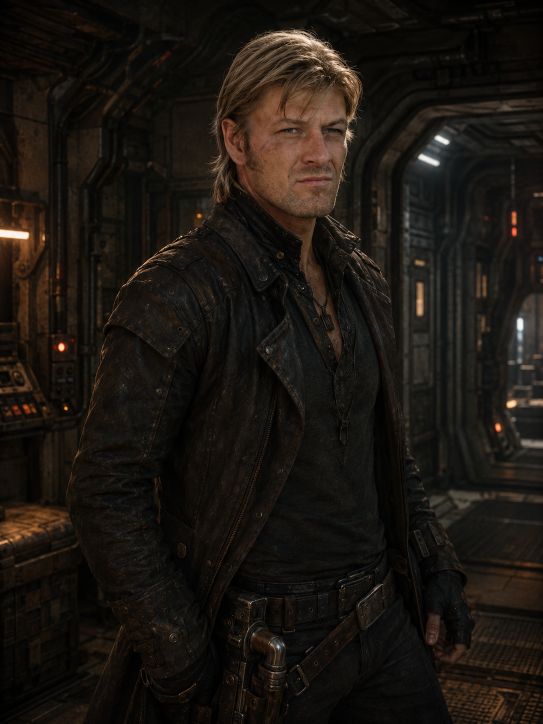


Combat Lead Ragnar Meral
Name Ragnar Meral
Position Rifleman
Rank Combat Lead
Character Information
| Gender | Male | |
| Species | Human-Betazoid hybrid | |
| Age | 35 | |
| Clearance Level (assigned by Command) | Gamma 4 | |
| Quarters Assignment (assigned by Command) | Crew Quarters, Deck 4 | |
| Roommate Assignment (assigned by Command) | Cormus Fletcher |
Physical Appearance
| Height | 6' | |
| Weight | 183lbs | |
| Hair Color | Light brown/Dark blond | |
| Eye Color | Green with a muted blue-grey ring | |
| Physical Description | Ragnar is around six feet tall, with a solid build that comes from keeping active rather than from training for appearance. He is broad through the shoulders, strong without looking bulky, and carries himself like someone used to relying on his body when he needs to. His hair is somewhere between light brown and dark blond, depending on lighting and exposure to the sun, and sits somewhere between having once been short and now needing a trim, practical more than styled, and he often has light stubble or a short beard if he has not shaved for a few days. His eyes are green, with a muted blue-grey ring around the iris that is only really noticeable up close. He is a good-looking man, but not in a polished way. His features are strong, with a straight nose, a solid jaw and the slightly worn look of someone who has lived a physical life and not been kept from it. He tends to look more approachable when he smiles, though he does not do it all that often. There are a few old scars on him that he never bothered to have removed, small marks rather than anything dramatic, the sort of thing that only really gets noticed if someone is close enough to see them. |
Financials - In Gold Pressed Latinum
| Share Payout Percentage (% received per job) (Command fills out) | 5% | |
| Current Amount Received (Paid out so far, Command updates after missions) | 0 Bars |
Personality & Traits
| General Overview | Ragnar Meral is intelligent, capable, and not always easy at first glance. He can come across as blunt, slightly tense, and unimpressed by anything that feels performative, but there is more warmth to him than people usually expect. He is loyal once trust is earned, perceptive in ways he does not always talk about, and more emotionally affected by others than he tends to let show. As a half-Betazoid, Ragnar has stronger empathic sensitivity than he usually admits, though it is unstable and not always reliable. He can pick up on mood, tension, fear, anger, and intent with enough force to be useful, especially in dangerous or crowded situations, but it does not come with the clarity or control of a trained full Betazoid. Some days it is little more than background noise. Other days, especially under stress, grief, fatigue, or in crowded spaces, impressions can come too sharply or blur with his own emotions. During his time in Starfleet he used prescribed blockers when needed. Outside Starfleet, access to them is less consistent, so he manages himself through distance, isolation, practical focus, and occasionally less healthy methods when he is not at his best. He has a dry sense of humour, a stubborn streak, and little patience for anyone who expects obedience without earning respect. Much of his early frustration was shaped by dyslexia, which made formal learning harder than it looked from the outside and left him with a lasting dislike of being underestimated. He prefers conversation over written communication, learns best through doing, and tends to rely on memory, observation, instinct, and the physical details of how people behave. Socially, Ragnar can be warmer than expected, but he does not let people close quickly. He has a habit of assuming distance before it exists and is more comfortable being relied on than being looked after. He is not especially comfortable with physical closeness unless it is clearly expected or under his control, partly because contact can make emotional impressions harder to ignore. At his core, Ragnar values competence, honesty, and loyalty he can trust. He is not interested in appearances for their own sake, and he has little patience for people who mistake bravado for strength. |
|
| Strengths & Weaknesses | Strengths • Reads rooms quickly, partly through empathy and partly because he has spent most of his life watching people before deciding what to do with them. • Stays useful when things turn bad and with a good aim and sense of fighting. • Once Ragnar trusts someone, he is hard to shift. He does not offer loyalty easily, but when he does, he means it and tends to stay even when things become difficult. Weaknesses • His empathic sense is not steady, and under stress it can give him too much at once or blur someone else’s fear, anger, or grief with his own. He can manage it, and has used blockers when needed, but it is not something he fully controls. • He does badly with people who expect obedience without earning respect. If pushed, he can go too far, especially when he thinks someone is hiding behind rank, power, or reputation. • Ragnar is slow to trust and slower to admit when he needs anything. He can assume distance before it exists, carry frustration too long, and make himself harder to reach than he means to. |
|
| Ambitions | To build a life that feels solid rather than temporary, even if he has stopped expecting respectable places to provide it. | |
| Hobbies & Interests | Close combat training, target practice, climbing, fieldcraft and survival skills, maintaining and modifying equipment, languages, tactical puzzles, and cooking. |
| Personal History | Ragnar Meral was born on Earth to a Human mother and a Betazoid father, though he did not grow up with either of them for long. His early childhood was unsettled, shaped more by absence than conflict. When his mother died while he was still young, and his father was unable or unwilling to take full responsibility for him, Ragnar entered Federation care before he had fully understood what was happening. He was old enough to remember life before it, which made the transition harder to ignore. What followed was not harsh in any official sense, but it was impersonal, and not every place he passed through left him untouched. He moved through a structured system of care, education, and oversight that ensured he was safe enough, fed, and taught, but never fully settled. He learned quickly that stability came from being useful, not from being wanted, and that adults were not always as reliable as the systems around them claimed they should be. Ragnar was an angry child, though not without reason. He got into fights with other children and, as he got older, with adults who thought authority was enough to make him obedient. Some of it was temper. Some of it was pride. Some of it was the kind of defensive instinct that formed before he had the language to explain it. He was rougher than many of the people around him, quicker to push back, and not especially interested in being made acceptable for other people’s comfort. By adolescence, he had already learned how to stand apart, how to watch a room, and how to make distance feel like a choice rather than another thing being done to him. Ragnar also struggled with written language from an early age, a difficulty later identified as dyslexia. It affected his reading speed, spelling, and the way he processed written information, particularly in structured learning environments where pace and accuracy were expected. While not uncommon, it was a source of ongoing frustration for him, especially as he was otherwise capable and aware enough to recognise the gap between what he understood and what he could easily demonstrate. As a child, that frustration often showed itself as impatience, temper, and a stubborn refusal to accept help when it felt too much like being pitied. Over time, he learned to compensate by relying on memory, listening, and pattern recognition, and became used to hiding the problem well enough that many people underestimated how much effort things took. He also showed early signs of empathic sensitivity, though it was inconsistent and never fully developed into the clarity seen in full Betazoids. He could pick up on mood, tension, and intent more easily than most, but without the control or understanding to rely on it completely. As a child, this made him perceptive but also unsettled, particularly in group environments where emotions were harder to separate from his own. It made him wary too, because he noticed irritation behind polite voices, pity beneath encouragement, and anger in people who had not yet raised their hands or voices. Over time, he learned to narrow his focus and trust observation as much as instinct, although the sensitivity continued to come and go rather than settle into something predictable. He did well enough academically to keep moving forward, though he was never considered exceptional on paper. What set him apart was not brilliance in the formal sense, but consistency, stubbornness, and a hard refusal to be written off. He listened, learned, adapted, and found ways round what did not come easily. Starfleet became a goal partly because it offered structure, but also because it gave him something to aim at. The desire to get in, and later to stay in, forced him to contain parts of himself that had previously come out as anger, fighting, and defiance. He did not become softer, but he became more controlled. Starfleet Academy was not easy for him. He entered later than some, after several years of further education and preparation, and never quite lost the feeling that he had come from somewhere rougher than most of the people around him. He was surrounded by cadets who seemed more polished, more certain, and more naturally suited to the institution than he felt. Ragnar settled into the expectations because he had chosen them, not because they came naturally. He performed steadily rather than standing out, fought harder than he admitted to keep up with written work, and learned when to keep his temper behind his teeth. His strengths leaned toward languages, situational awareness, analysis, and reading intent, which led him toward Starfleet Intelligence. There, he spent years working in environments that rewarded independent thinking, flexibility, and a willingness to operate outside strict procedural boundaries when required. Starfleet also gave him better access to training and medical support for his empathic sensitivity, including blockers when the noise became too much, though he never liked relying on them more than necessary. It was during this period that Ragnar formed the closest relationships of his adult life, although he was not easy to reach at first. Working alongside two other operatives, Jack Kirkwall and Scarlet Varro, what began as a professional partnership developed into something more personal and more complicated. Ragnar was useful before he was comfortable, blunt, guarded, and always ready to pull back before anyone else could. Jack had a way of easing him without making a project of him, using humour, steadiness, and patience without ever making Ragnar feel handled. Scarlet trusted him in a way he understood better, practically and without fuss, putting work and risk in his hands often enough that he eventually had to believe it was real. The three of them operated as a unit in more than just the formal sense, relying on each other in ways that blurred the line between duty and attachment. It was not something Ragnar had ever expected for himself, and for a time it gave him a sense of belonging he had not had since childhood. He was not always good at showing it directly, but he learned the small practical shapes of care with them, including cooking when they had the time and privacy for something that felt less like a ration and more like a shared life. During the Dominion War, that bond became harder and more necessary. Ragnar, Jack, and Scarlet worked as Intelligence operatives through some of the less visible parts of the conflict, gathering information, assessing intent, handling contacts, and operating in situations where formal lines were not always clear. Their work was rarely clean and almost never simple, but they learned how to move together, how to read the same room from different angles, and how to trust each other when there was no time to explain. By the end of the war, the unit was no longer just professional. It had become the closest thing Ragnar had to a home. That did not last. Not long after the Dominion War ended, Jack was killed during an operation. The details are not something Ragnar speaks about. Scarlet was present. Ragnar was not. In the aftermath, whatever held the three of them together broke. Scarlet left soon after, and Ragnar did not follow. Whether by choice or circumstance, the connection ended without resolution. The loss took more from Ragnar than he knew how to admit. Jack had eased something in him, and Scarlet had trusted him in a way that made him feel anchored, even when the work was at its worst. With Jack dead and Scarlet gone, that small network of trust disappeared almost overnight. What was left was Starfleet, the work, and a version of himself he had thought he had outgrown. He remained in Intelligence for a time, but the work became harder to sustain. The role required him to remain open to ambiguity, to read intent, to trust instinct and interpretation, all things that had once suited him and now rubbed too close to the nerve. His empathic sensitivity became less predictable again, sharpened by grief and lack of sleep, and nightmares he had not had for years began to return. He got colder with people, then sharper, and when anger came it came faster than it had in a long time. At first, he contained it well enough. He had learned how to do that. But containment was not the same as control, and the pressure began to show. He argued with senior officers, pushed against decisions he thought were careless or dishonest, and became increasingly difficult to manage in a structure that had already started to feel too narrow. There were incidents, most of them small enough to be handled quietly, until one confrontation with a commanding officer escalated beyond professional disagreement and crossed into physical altercation. The official record cites conduct and failure to adhere to command structure. The unofficial version is simpler: Ragnar was frayed, angry, and pushed back too hard against the wrong person. Starfleet did not discharge him, but the options offered felt more like containment than support. Reassignment, review, counselling, and a quieter role were all discussed, the sort of solutions that would have kept him useful while moving the problem somewhere less visible. Ragnar might once have accepted that, if only because structure had always been safer than uncertainty. This time, he did not. He had spent too much of his life being placed where other people thought he would do the least damage, and he was tired of mistaking that for belonging. Rather than accept reassignment into a role where the problem could be kept quieter, Ragnar resigned. After leaving Starfleet, Ragnar took work where he could find it. Cargo escort, private security, salvage assessment, and discreet jobs for crews that needed someone capable enough to notice trouble before it became expensive. Some of it was legal, some of it sat between jurisdictions, and some of it depended entirely on who was asking the question. Ragnar was not drawn to crime for its own sake, but he had no romantic ideas about legality either. He understood practical work, risk, and the fact that law and right were not always the same thing, especially after the Dominion War had left so much of the Gamma Quadrant unstable. It did not make him happy, not at first, but it gave him room. Outside Starfleet, no one expected him to fit cleanly into a shape he had already outgrown. The work was often rough, unreliable, and morally uncomfortable, but it was honest about what it was. Over time, he found a steadier rhythm in it. He slept better when he was tired for practical reasons. He trusted himself more when decisions had immediate consequences rather than disappearing into reports. He began to understand that peace, for him, was never going to look polished or respectable. It was more likely to be a quiet bunk, a job completed, a weapon cleaned, a meal cooked for people who had earned it, and enough distance from the past that it no longer had its hand around his throat. By 2380, Ragnar had spent several years moving through that kind of work, building enough of a reputation to be useful without becoming too visible. His Intelligence background made him valuable to privateers, traders, smugglers, and crews operating outside the main shipping lanes, especially when a false manifest, bad deal, or hidden threat needed spotting before weapons came out. He is not sentimental about legality, but he has lines he does not treat as negotiable, and he will not knowingly support slavery, trafficking, civilian massacres, or cruelty for entertainment. Ragnar does not consider himself a pirate, though he understands other people may not see the distinction as clearly as he does. What he still wants is a life that feels solid rather than temporary, even if he has stopped expecting respectable places to provide it. |
|
| Service Record | 2345 - Born on Earth to a Human mother and Betazoid father 2352 - Enters Federation care following the death of his mother 2365 - Enters Starfleet Academy after several years of further education and preparation 2369 - Graduates Starfleet Academy and enters Starfleet Intelligence 2370 - Begins field intelligence work, with a focus on languages, situational analysis, and intent assessment 2371 - Assigned to operations alongside Jack Kirkwall and Scarlet Varro 2373 - Continues intelligence operations during the Dominion War 2375 - Completes wartime intelligence service following the end of the Dominion War 2376 - Jack Kirkwall is killed during a post-war operation 2376 - Scarlet Varro leaves Starfleet Intelligence shortly afterwards 2377 - Resigns from Starfleet following disciplinary review and rejected reassignment 2377 - Begins private contract work, including cargo escort, salvage assessment, and security work outside Federation space 2378 - Works increasingly around Gamma Quadrant trade routes and post-war recovery zones 2380 - Joins the crew of the Dutchman in the Gamma Quadrant |