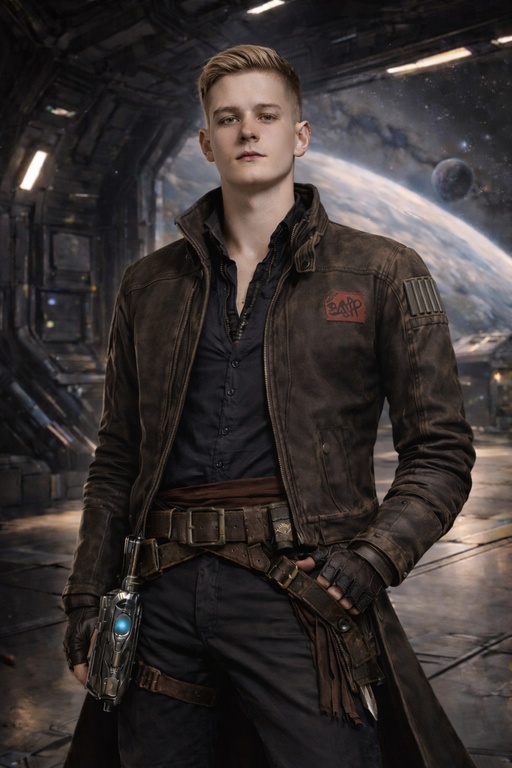

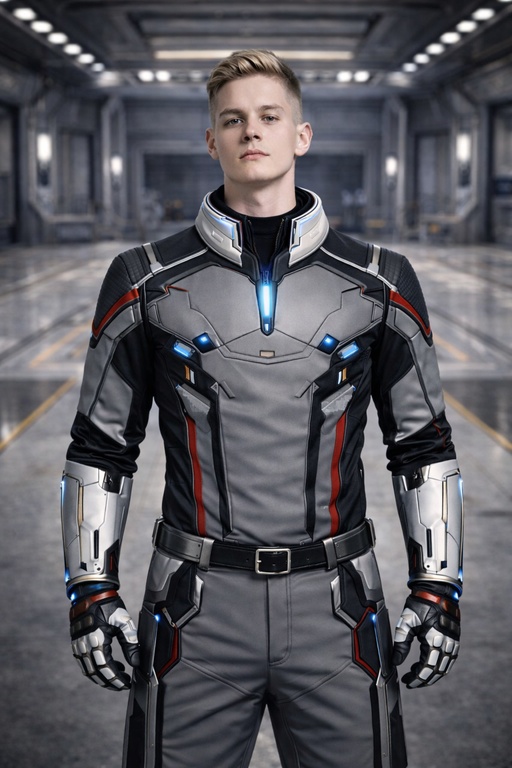
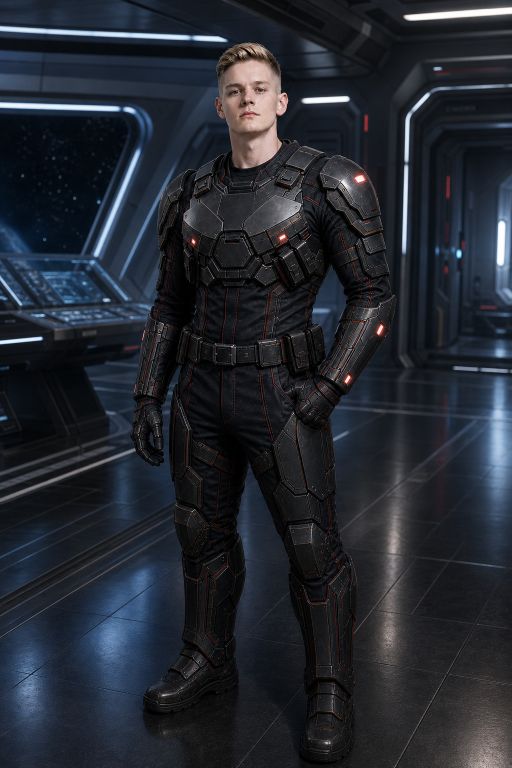

Flight Lead Cormus Fletcher
Name Cormus Fletcher
Position Lead Support Craft Pilot
Rank Flight Lead
Character Information
| Gender | Male | |
| Species | Human | |
| Age | 23 | |
| Birthday | 7/19/2056 | |
| Clearance Level (assigned by Command) | Beta 4 | |
| Quarters Assignment (assigned by Command) | Crew Quarters, Deck 4 | |
| Roommate Assignment (assigned by Command) | Ragnar Meral |
Physical Appearance
| Height | 5' 7" | |
| Hair Color | Blond |
Financials - In Gold Pressed Latinum
| Share Payout Percentage (% received per job) (Command fills out) | 2.75 % | |
| Current Amount Received (Paid out so far, Command updates after missions) | 0 Bars | |
| Other Funds (Latinum you want your character to have prior to joining ship, player may fill out) | 10 Bars |
Family
| Father | Dr. Elias Fletcher (54) | |
| Mother | Dr. Marisol Fletcher (52) | |
| Sister(s) | Tamsin Fletcher (19) |
Personality & Traits
| General Overview | Cormus takes to high risk situations the way most people take to a familiar routine. He is confident and energetic and at his best when someone hands him a problem and trusts him to handle it without hovering over his shoulder. Long deliberation is not really his style. He would rather make a call with half the information and adjust on the fly than wait around for a perfect picture that may never come. Years of flying support craft under all kinds of conditions have made that instinct reliable more often than not. He is easy to be around. Informal, quick with a joke, the kind of person who can walk into a room full of strangers and find his footing in about thirty seconds. What can read as cockiness on the surface is usually just genuine confidence, and there is a difference, though he would be the first to admit the line blurs occasionally. He respects skill and experience above most other things, especially in pilots and engineers who have proven themselves somewhere that actually required it and not just claimed to. He is young and he knows it, at least more than he used to. The time he has spent operating on the frontier and in the Gamma Quadrant has started to sand down some of the rougher edges of his recklessness. He is getting better at reading when pushing a limit is the right call and when pulling back is the smarter one. That balance is still something he is working out and probably will be for a while yet. |
|
| Strengths & Weaknesses | **Strengths** Cormus slots into a new crew faster than most people manage and a lot of that comes down to the fact that he reads environments well and adjusts without making a production of it. He earns trust through what he does rather than what he says, which tends to matter more in the kinds of places he has worked. When things start going sideways he stays steady, or at least projects steady, and that has a way of keeping the people around him from unraveling when they might otherwise. For the crewmates he flies with regularly he is the kind of person who shows up when it counts and doesn't need to be asked twice. He works best when he knows what is expected of him and he takes to mentorship well as long as the person doing it leads by example rather than rank. When he decides someone's judgment is worth trusting he commits to it fully and without a lot of second guessing. **Weaknesses** His confidence has a way of getting out ahead of his actual assessment of a situation, and he has taken on more than he was fully ready for often enough that it has cost him. In personal relationships this can show up as over commitment or a reluctance to say out loud that he is in over his head. He is still working on the habit of slowing down and talking things through with others instead of just trusting his own read and moving. Emotionally he tends to keep things moving rather than sitting with them. He deflects with humor more often than he probably should and while it usually lands well enough in the moment it can create distance with people who are looking for something more from him. He knows this about himself to some degree but knowing it and doing anything about it are different things. |
|
| Ambitions | Cormus wants freedom and the chance to keep getting better at what he does. He finished his mandatory Starfleet service, saw enough of structured and regulated environments to know they were not for him long term, and came out the other side with a clear preference for autonomy over stability. In the short term he wants to keep expanding, more vessel types, more complex environments, situations where skill and judgment actually matter and credentials are just a footnote. He is motivated by the challenge itself as much as anything else and he does his best work when the stakes are real and the margin for error is narrow. What he is looking for in the long run is harder for him to articulate but he is starting to get a sense of it. An operation that offers both independence and continuity, somewhere he can build real connections without having to trade away the freedom that matters to him. He has spent enough time on short contracts and transient crews to know that something is missing from that kind of life even if he has not quite named it yet. There is an appetite for belonging underneath the confidence and the easy manner, something that goes beyond just flying well and moving on, and it is starting to push up against the surface whether he is ready to look at it directly or not. |
|
| Hobbies & Interests | Cormus grew up active and never really stopped. Rock climbing is the one thing he comes back to consistently wherever he ends up, and he gravitates toward the harder ascents, the ones that require actual focus and controlled movement rather than just physical effort. It does for him what a lot of things can't, it quiets the noise and keeps him sharp in ways that carry over into the cockpit whether he thinks about it consciously or not. When he is not climbing he is usually tinkering. Small craft systems, handling controls, responsiveness, the kind of adjustments that most pilots leave to whoever maintains the ship. He likes understanding exactly how something behaves and then making it behave better. That same interest pulls him toward simulators, not for formal training but for the personal challenge of running scenarios that have no good outcome and seeing how close he can get to finding one anyway. Socially he does best in informal settings. He is drawn to environments where what you have actually done carries more weight than what your rank says you should be able to do, which is a preference that his time around New Ferenginar did a lot to reinforce. |
| Personal History | Cormus Fletcher was born in South America where his parents were geologists. His childhood was built around extended field expeditions into remote areas, dense jungles, mountain ranges, and exposed geological formations that most kids his age would never have seen up close. Those years gave him a self reliance and a comfort with physical risk that he carried forward into everything that came after without really thinking about where it came from. Growing up in that kind of terrain he gravitated toward physical pursuits early on. Rock climbing became a favorite past time as he got older. He also got into hang gliding for a while which introduced him to controlled flight and the fundamentals of reading wind and momentum and conditions in a way that would turn out to be useful later. Both of them fed the same thing in him, the confidence that came from moving through an environment that could hurt you if you stopped paying attention. As a teenager, he became interested in smaller craft that flew. He took time to pilot skiffs and play around with drones whenever he could. That habit of pushing things further than was strictly sensible caught up with him not long after his eighteenth birthday when a stunt he pulled with a group of friends went badly wrong and left a significant amount of property damaged in the process. He was given a choice between incarceration and mandatory Starfleet enlistment and he chose to enlist, partly because he recognized the training for what it was worth and partly because the alternative was worse. He went in as a support craft pilot and specialized in shuttle operations, auxiliary vessels, and short range missions. He had a strong aptitude for precision flying and close quarters maneuvering and his performance stayed solid throughout even when his confidence pushed up against the edge of what people were willing to tolerate from someone his age. He finished out his two years in good standing and when his service was up he walked away without much deliberation about it. At twenty he moved into civilian space with a license and started taking contracts on his own through the Beta Quadrant, support craft and utility work for couriers and cargo ships and light escorts and hazardous retrieval operations. A lot of the vessels he flew during that period were old or heavily modified and support was minimal at best which meant he learned fast how to stay mechanically aware of whatever he was flying and find ways to maintain it when the situation called for it. Those years sharpened his instincts more than the formal training had. After about a year working on his own he picked up a series of contracts that took him through the Bajoran wormhole and into the Gamma Quadrant. He ended up based in and around New Ferenginar, an independent world that had broken away from the Ferengi Alliance and held hard to the old ways, profit driven and loosely regulated and full of opportunity if you were willing to operate in conditions that more cautious pilots tended to avoid. He flew for guilds and independent merchants and trade outfits that had no affiliation with anyone in particular, cargo transport and personnel movement and equipment delivery and short range escorts between local systems. The contracts were aggressive and the expectations shifted between jobs and the clients almost universally prioritized profit and speed over safety. Flying out there pushed him toward his own judgment by necessity and it also pushed him toward taking preparation more seriously than he ever had before, not because anyone told him to but because he saw quickly enough what happened when you didn't. He is twenty three now and still working as an independent support craft pilot, drawing on experience across two quadrants and a wider range of operational environments than most pilots his age have seen. It has positioned him well for the kind of work that happens beyond more formal structures, which is exactly where he intends to keep operating. |
|
| Service Record | **2357** Cormus Fletcher grew up in South America, the son of two geologists who spent more time in the field than at home and brought him along for most of it. **2375 to 2377** Shortly after his eighteenth birthday a stunt that went badly wrong with a group of friends left a significant amount of property damaged and put him in front of a choice between incarceration and mandatory Starfleet enlistment. He chose to enlist. He went through training as a support craft pilot on the enlisted track and spent his service flying shuttles and auxiliary vessels, mostly personnel transport and cargo movement and short range missions that didn't make it into anyone's record as particularly notable but added up to a lot of hours in the seat. He had a natural aptitude for it and his performance stayed solid throughout even when his confidence pushed up against the edge of what people were willing to tolerate from someone his age. He finished his service obligation in good standing and when it was up he walked away without much deliberation about it. **2377 to 2378** At twenty he moved into civilian space with a license and started taking contracts on his own through the Beta Quadrant. Courier runs, light escort duty, hazardous retrieval, utility piloting, the kind of work that kept him moving and rarely put him in the same place twice. A lot of the vessels he flew during that period were old or heavily modified and support was minimal at best, which meant he learned fast how to stay mechanically aware of whatever he was flying and sort out problems without waiting on anyone else to do it. **2378 to 2380** Better paying contracts pulled him through the Bajoran wormhole and into the Gamma Quadrant. He ended up based in and around New Ferenginar, an independent world that had broken away from the Ferengi Alliance and held hard to the old ways, profit driven and loosely regulated and full of opportunity if you were willing to operate in conditions that more cautious pilots tended to avoid. He flew for Ferengi guilds and independent trade outfits with no affiliation to anyone in particular, cargo transport and personnel movement and equipment delivery and short range escorts between local systems. The contracts were aggressive and the expectations shifted between jobs and the clients almost universally prioritized profit and speed over safety. Flying out there pushed him toward his own judgment by necessity and toward taking preparation more seriously than he ever had before, not because anyone told him to but because he saw quickly enough what happened when you didn't. **2380** Cormus is twenty three and still working as an independent support craft pilot, drawing on experience across two quadrants and a wider range of operational environments than most pilots his age have seen. He is looking for something longer term now, a crew and an operation that offers real autonomy and challenge and room to keep growing without having to give up the freedom that matters to him. |