The shuttlebay on the Dutchman was alive with the familiar whine of diagnostic tools and the sharp scent of plasma coolant. One of the Type-11s sat in the center cradle, port nacelle pylon open, impulse manifold partially disassembled, and flight computer access panels removed. The impulse drive had been throwing power fluctuations, intermittent voltage drops traced to injector timing drift and nozzle erosion. The starboard nacelle pylon had a hairline stress fracture in the primary structural spar from a micro-meteor impact. Worst was the flight computer, subroutine corruption in the attitude reference buffer kept throwing false roll and yaw warnings, risking autopilot disengagement in combat or high-G maneuvers.
Cormus was already under the impulse housing with a tricorder in one hand and a plasma torch in the other when Mei-Lin walked in with her toolkit and a fresh mug of tea.
"You always start without me?" she asked, her voice carrying over the noise.
"Only the fun parts" he replied. "The impulse manifold was throwing codes again, injector timing's off by 0.6 milliseconds at peak. I pulled the nozzles already and they're trashed, carbon scoring on the inner surfaces and throat erosion at 18 percent. Power relays are suspect too, I felt a stutter in the thrust curve on the last test run."
She set her mug down moved over beside him. "Good catch. The fluctuations are tied to the injector timing matrix, it's misfiring under load and starving plasma flow at high thrust. We'll need to recalibrate the timing sequencer and swap the nozzles out. Did you pull the spares already?"
"Already pulled them," Cormus said, handing her the damaged set. "The carbon buildup's bad, inner throat diameter reduced by 0.4 mm. The relays look okay on visual but I want to run a load test before we button it up. Last thing we need is a voltage spike taking out the EPS manifold."
She joined him under the craft. "Agreed. And Lindsy's structural scan showed the nacelle fracture has grown 0.2 mm since yesterday. It's still hairline but under full impulse or high-G it could propagate. We'll need a duranium patch and a full SIF test after, and we should push it to 110 percent for margin."
Cormus passed her the molecular welder. "You take the pylon then, I'll finish the impulse assembly. The computer's still throwing attitude errors too, subroutine corruption in the buffer. It keeps thinking we're rolling 1.2 degrees when we're dead level."
Mei-Lin reached for the probe. "I'll purge and reload the nav module after we finish the hardware. It should clear it up but we'll want a full calibration run before we sign off on her, static first then dynamic in the bay."
They worked in easy tandem for the next hour or so. Cormus handled the physical teardown while Mei-Lin reinforced the pylon and ran structural diagnostics and their conversation drifted in and out between the work.
"Can you hand me the 3 mm duranium patch?" Cormus asked, his voice muffled from inside the nacelle.
Mei-Lin passed it over without looking up from what she was doing. "Watch your heat on that welder. The alloy's thin at the fracture zone, one wrong pass and we're making more work for ourselves."
"Relax, I've patched worse with spit and hope," he said and she could hear the grin in it. "You should've seen the runabout I flew out of Tautine last year, it had a hull breach and half the impulse drive was offline and I still got her home."
"That's impressive," Mei-Lin said. "Also pretty stupid."
"Hey, stupid works when it's the only option." He made a final pass with the welder and slid back out to check it. "The pylon's reinforced. Go ahead and run the SIF test."
Mei-Lin ran the scan and watched the numbers come up. "Integrity field is stable, green across the board. Good work."
Cormus wiped the sweat off his forehead with the back of his hand. "Your turn on the computer. I'll start closing up the impulse assembly."
She moved to the cockpit and slid into the pilot's seat and the console lit up under her touch, error logs scrolling. "The corruption's isolated to the attitude sensor buffer. I'm purging it now and reloading from backup."
Cormus's voice drifted in from the rear. "How long have you been doing computer work?"
"Long enough," she said, her fingers moving over the controls. "Freighters don't always come with clean systems so you learn to fix what's in front of you."
He poked his head into the cockpit doorway. "That sounds familiar. Starfleet taught me the book way and real space taught me the rest."
Mei-Lin glanced over at him for a second. "Do you miss it? The structure?"
Cormus leaned against the frame and thought about it for a moment. "Sometimes I do. There's something to knowing exactly what's expected of you. But mostly no. Out here I get to decide what matters."
She nodded slowly and kept working. "I had structure once. The Academy, a clear chain of command, all of it. Then one bad night and one wrong association and I was out. There was no appeal, just a discharge code and a door closing behind me."
Cormus was quiet for a second. "That's rough. I did my two years enlisted and got out clean but I saw guys who didn't. One mistake or one bad CO and suddenly you're radioactive to everyone."
Mei-Lin looked up from the console. "Yeah. But it taught me that systems break and people break them and you either fix what's in front of you or you walk away." She turned back to the screen. "I chose to fix."
He didn't say anything to that for a moment. "I'm glad you did," he said finally and then disappeared back into the rear of the shuttle.
She kept her eyes on the console. "The computer's clean. Attitude sensors are recalibrating now, give it five minutes and we can run the static test."
Cormus dropped into the co-pilot seat. "I'm ready when you are."
The console chimed and Mei-Lin leaned back and looked over the readouts. "The manifold and pylon should hold. Computer's green."
Cormus powered up the shuttle and the impulse drive came to life, running smooth with no stutter. The attitude sensors held steady and no warnings came up.
He let out a slow breath. "She's ready to fly."
Mei-Lin smiled a little at that. "We did good."
"Yeah," he said, looking over at her. "We really did."
They sat in the cockpit for a bit longer with the shuttle's systems idling softly around them before Cormus said anything else.
"You know I wasn't sure what to expect when Zedd hired you. I thought we'd get someone who'd just punch numbers and stay buried in engineering."
Mei-Lin looked over at him. "And?"
He shrugged. "You listen to the ship like it's talking back."
"It does talk back," she said. "You just have to know how to listen." She started closing out the diagnostic screens. "And you're not just a hotshot pilot either. Most people with your skills would've flown it until it broke. You caught the problems early."
"It was a team effort," Cormus said. "The ship's gotta trust us before we can trust it."
She laughed softly at that. "That's true. And it's starting to, just listen to her."
Cormus glanced at the console and then back at her. "You know what, I think we make a pretty good team."
Mei-Lin's smile stayed small but it was there. "Don't get ahead of yourself. I like the shuttle. You're just the guy who flies it."
He laughed at that, loud enough that it bounced around the cockpit. "Fair enough. But I'm the guy who flies it well and I'm the guy who's buying the next round when we hit port."
Mei-Lin raised an eyebrow at him. "Only if you promise not to crash us before we get there."
"Scout's honor," he said, holding up three fingers.
"You were never a scout."
"Those are just details." He stood up and grabbed his toolkit off the console. "Come on, let's go tell Zedd she's flight ready and see if we can talk him into letting us take her for a spin."
Mei-Lin stood up and grabbed her own kit. "Lead the way, hotshot."
They walked out together and headed for the turbolift and as they went Cormus glanced sideways at her. "You know, for someone who spends half her time buried in warp cores you're pretty good company."
Mei-Lin shook her head at him but she was smiling. "And for someone who spends his life chasing speed you're surprisingly patient when it counts."
"Don't tell anyone" he said. "It ruins my reputation."
"Your secret's safe," she said and bumped his shoulder lightly as they walked. "But if you ever need help keeping up with the ship you know where to find me."
"And if you ever need someone to fly you out of trouble, I'm your guy" he said with a grin.
The lift doors closed behind them and the shuttlebay went quiet again. The Type-11 sat in its cradle, patched and calibrated and ready to go.
A Busted Wing
✦ Featuring ✦
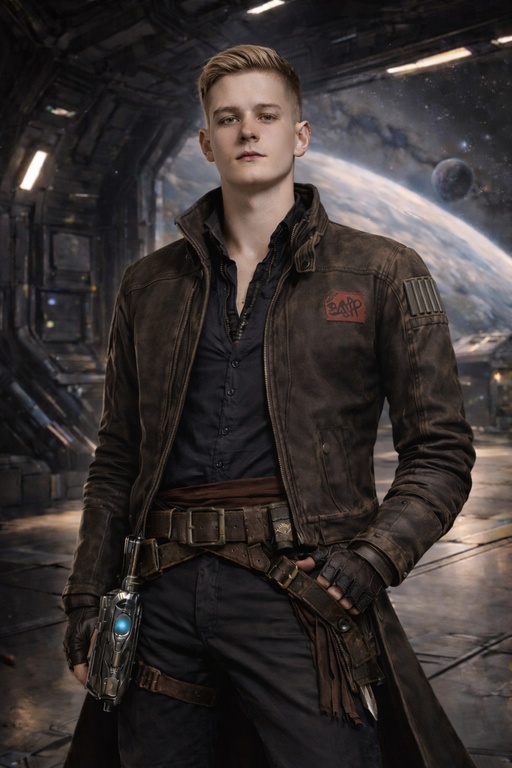
Cormus Fletcher

Mei-Lin Zhao
Acquisitions & Contracts