
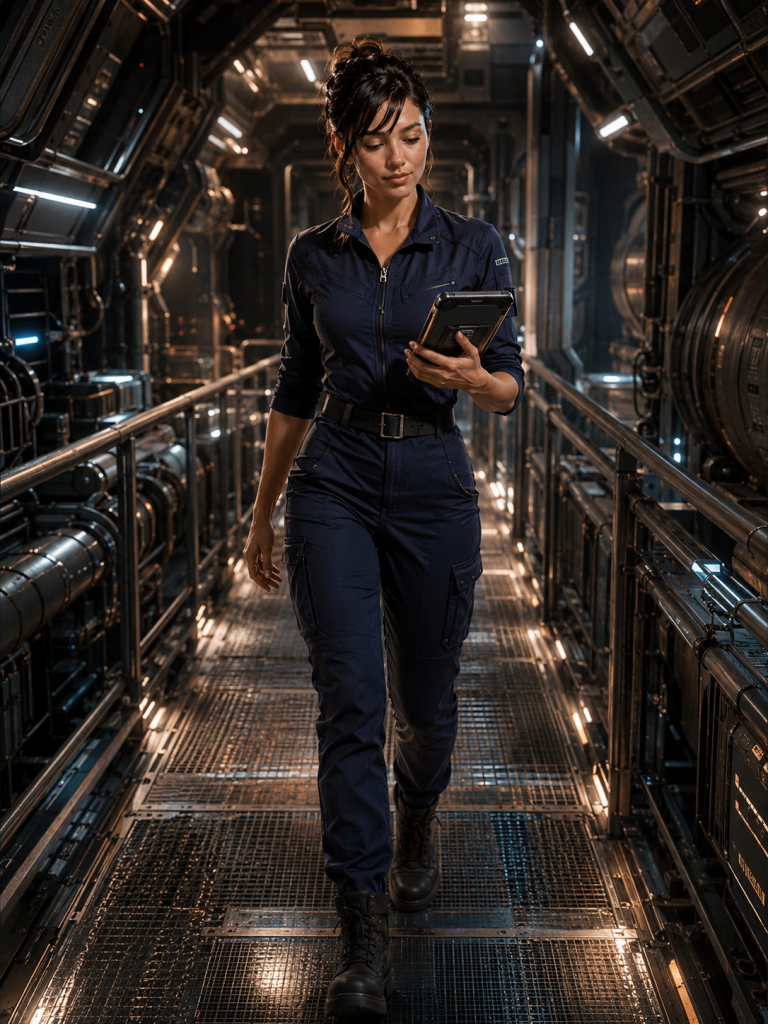

There was an area reserved specifically for the computer core, located on the main engineering deck. The housing itself was approximately 2 meters high by 1 meter wide. It hummed slightly; the frequency was distinct from anything the ship had previously processed. This processing frequency was indicative of how hard the Dutchman's computer core was being pushed. There were several areas where the core limited what Zedd envisioned the Dutchman could do. For example, there was a delay in navigation processing that Lindsy had noted during her first week. In addition, there were some diagnostic logs indicating delays in integrating sensors and a hesitation to do multiple tasks at once. All these issues originated with the age of the Dutchman's processing architecture, which had been cutting edge in 2371. However, the age of the Dutchman's processing architecture was now outdated.
Tiraa arrived sooner than he anticipated.
When he brought her onboard, he and she established an agreement regarding what questions would be asked and what information would be provided. He was prepared to abide by that agreement. What was important to Zedd was what was contained in the center of the engineering bay in its shipping container. A shipping container that was roughly comparable in size to the Dutchman's original core (approximately 2 meters x 1 meter) however had a much greater mass. Thus, there was clearly a lot going on inside. The specifications that Tiraa sent were impressive. The bio-neural cluster of the new core was integrated with standard isolinear backup architecture. Furthermore, the cluster had adaptive learning capabilities, which allowed it to learn and adapt to changing situations in real-time. Additionally, the new core integrated all sensor data across all arrays simultaneously and included a ship systems management layer that could monitor and adjust virtually all aspects of ship operations, including life support and weapons power distribution without requiring a crew member to identify an adjustment.
The new core also included voice interface technology that was significantly more advanced than the standard computer response system utilized by the Dutchman. Zedd was withholding his opinion concerning this feature until he actually heard it.
Mei-Lin spent twenty minutes examining the shipping container for the new core. Her examination was characterized by the expression she assumed when she was building a complete picture prior to making a decision.
"Walk me through the process for installing this thing," she stated, without taking her eyes from the shipping container.
"We will start by transferring the data from the existing system to the backup isolinear banks," Zedd explained, accessing the technical diagram of the Dutchman on the wall display. "Once we've transferred all of our knowledge about ourselves to safe storage we'll be able to initialize the new core and verify that the data transfer occurred without error."
"How long will that take?"
"It will take about forty minutes. We will transfer the data at sixty percent capacity due to limitations inherent to the backup banks in use on this vessel."
Mei-Lin directed her attention toward him. "You have performed this type of installation before."
"Yes," he replied. "I performed this type of installation once, on a ship that was considerably more difficult to work with than this one. My experience performing that installation is why we're reducing the capacity to fifty percent."
Mei-Lin acknowledged that explanation and returned her focus to the shipping container. "The bio-neural cluster... I am familiar with bio-neural clusters, although I have never installed one. Bio-neural clusters are more sensitive to the initialization sequence than isolinear architecture. Therefore, if the environmental conditions in the alcove are not within specification when we activate the cluster it will degrade and you won't have another opportunity to successfully initialize it."
"What do you require?"
She was already en route to the environmental control panel mounted on the opposite side of the engineering bay. "Temperature in the alcove must remain constant between 18C and 22C throughout the initialization phase. Humidity must remain at 40% or lower. Finally, I wish to isolate the power feed to the alcove from all other power feeds used in engineering so we don't deal with fluctuations caused by other systems using the same feed."
She accessed the temperature and humidity reading displays on the panel and examined them. "Current temperature is 24 C; humidity is 43%."
"How long will it take to reach spec?"
"If I correct both parameters now," Mei-Lin responded, "it will take approximately thirty minutes."
They could initiate the data transfer while awaiting stabilization of the environmental conditions in order to maintain their schedule.
Zedd nodded and initiated the data transfer procedure for the existing system. The data transfer process involved extracting all information regarding the Dutchman's operational history, navigational records, systems performance characteristics, crew access procedures, and all decisions that had ever been made by the Dutchman since commissioning and storing those records in safe isolation until such time as the new core was prepared to accept them.
The progress bar associated with the transfer displayed on the wall display as it progressed slowly across its total distance.
✦ Featuring ✦
♥ 0