
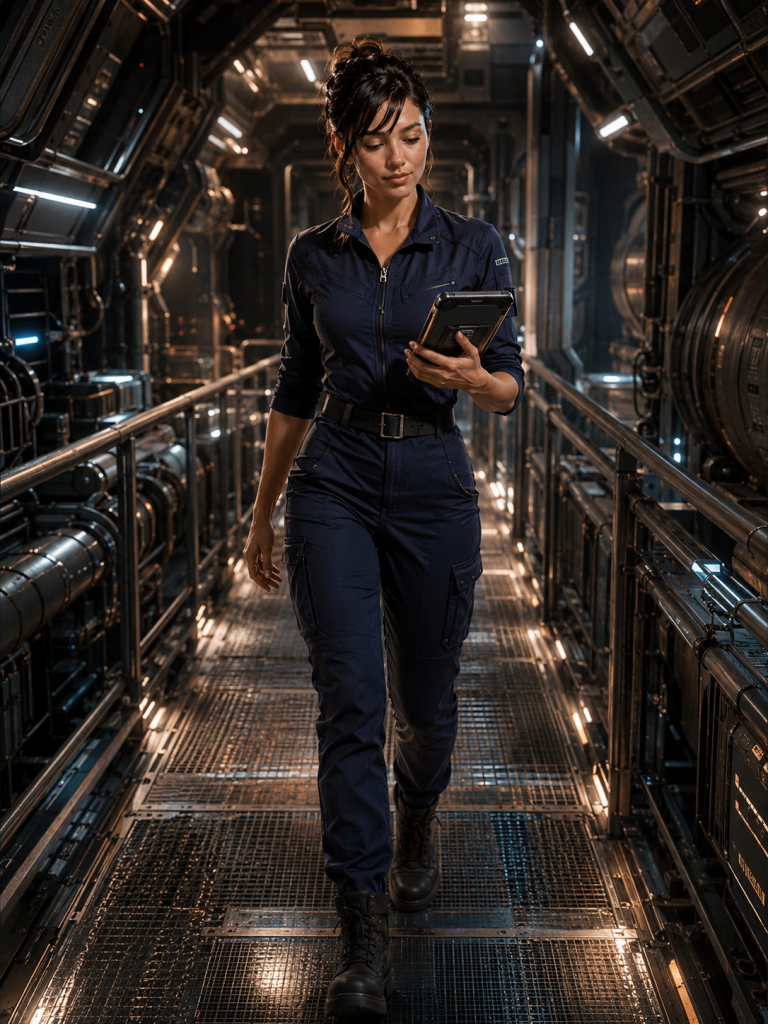

Mei-Lin walked away from the environmental control panel after verifying that all required parameters were consistent with requirements and initiated a scan across each seam of the shipping container utilizing her scanner. The manner in which she scanned across each seam was identical to how she always scanned everything; she sought information that was omitted from specifications rather than validating information provided by specifications.
"The cluster density is twelve percent above what is specified in your specs," Mei-Lin reported.
Zedd addressed her. "That is a problem."
"Not necessarily," Mei-Lin countered. "Twelve percent more processing density implies that there is additional headroom available to the adaptive learning layer than we had planned for. The system will be faster and more intelligent than suggested by documentation." Mei-Lin terminated scanning and directed her gaze toward Zedd. "The person who sold us this wasn't merely selling us a good core; he/she/they sold us a superior product."
Zedd remained silent, filing this observation as well as others related to Tiraa, together with what it implied about Tiraa's initial substantial contribution to the Dutchman relative to his request for it.
The data transfer concluded after 43 minutes, three more than Zedd had estimated, primarily due to an older backup bank being slower than diagnostic results had indicated. Upon completion of the data transfer, the wall display reflected clean data integrity across all transferred files and that the existing core was functioning solely upon backup systems maintaining only life support and basic ship operations while all other systems were idle awaiting receipt by the new architecture.
Mei-Lin reviewed environmental parameters in the alcove. "19.4 degrees C., 38% humidity. Isolation of power feed from remaining engineering systems."
Mei-Lin directed her gaze toward Zedd. "We are in compliance."
"Let's remove it from that box," Zedd said.
The shipping container opened with a hydraulic hiss characteristic of a sealed unit releasing pressure and allowing release of its contents onto its mounting bracket. The new core emerged on its bracket from beneath the shipping container. Its matte-black surface reflected light emanating from engineering bay illumination in a manner that made it appear less like a mechanical component and more like something that had determined where it would reside and approved of that determination. They carefully positioned it before placing it into position in front of the alcove with similar deliberation and measured tempo employed by two individuals who recognized that subsequent events were best not hurried.
Mounting brackets attached with a degree of accuracy equivalent to previous attempts with respect to positioning of brackets relative to housings of previous cores and locking into place with considerable solidity.
"Isolate power feed," Mei-Lin said.
"Anytime," Zedd responded.
She conducted a final verification of environmental parameters in alcove, 19.7 degrees C., 37%, power feed clean and isolated, and input initialization sequence into panel controlling activation sequence.
The core activated gradually, beginning with sounds below audible limits and increasing to operational frequency of system doing much more than predecessor within approximately thirty seconds.
The wall display rapidly became filled with initialization data relative to ship systems at rate greater than either Zedd or Mei-Lin had observed a computer core fill with data. As new core identified ship systems in real-time, it developed a comprehensive understanding of ship systems.
Then voice activated:
"Initialization complete." The voice interface did not respond in flat tone characteristic of standard computer systems. Instead it possessed a certain presence absent intrusion; attentiveness absent pretension. "Ship Systems Nominal, Data Transfer Verified Clean Across All Backup Banks, Baseline Calibration Commencing"
Zedd directed his gaze toward Mei-Lin. She returned his gaze.
Zedd extended his neck-mounted dataport cable into auxiliary interface connector on housing containing new core. Connection occurred instantaneously as port on cable established connection with core with minimal lag (less than three seconds) experienced previously when attempting direct system access via port instead of employing standard interface.
The new core was fast, faster than any system Zedd had accessed directly outside of Starfleet facilities and considerably faster than he believed possible for system acquired from Tiraa's network in shadows of New Ferenginar's black markets.
He accessed diagnostic overlay through dataport cable and permitted overlay to traverse his perception for moment, displaying systems onboard ship with clarity and detail unattainable under previous configuration, not merely system operating statuses but interdependencies among systems; how EPS grid distributed load across ship; minor thermal variation in the port plasma relay on Mei-Lin's maintenance log; how power distribution between warp core and secondary systems varied given new crystals were installed/calibrated. Both systems existed simultaneously in his perception creating clear image of a ship whose overall condition was improved substantially over past week's condition, and would continue improvement based on additional functionality provided by new core once completed baseline calibration and initiated adaptive learning processes.
✦ Featuring ✦
♥ 0